Yes, spray foam roofs can absolutely be repaired after hail damage. Unlike traditional roofing materials that often require full replacement, spray polyurethane foam (SPF) roofs offer remarkable resilience and repairability. Hailstones can dent, crack, or gouge the surface coating and underlying foam, but with the right techniques, these roofs can be restored to full functionality, extending their lifespan significantly. This comprehensive guide draws from proven industry practices and real-world applications to explain how repairs work, what to expect, and why SPF roofs excel in hail-prone conditions.
Spray foam roofing has gained popularity for its seamless, fully adhered design that creates a leak-resistant barrier. When hail strikes, the damage severity—ranging from minor surface pits to deeper foam fractures—determines the repair approach. Minor issues might need just caulking, while severe cases involve scarifying damaged areas, re-foaming, and recoating. This adaptability makes SPF one of the most repair-friendly roofing systems available today.
Understanding Hail Damage on Spray Foam Roofs
Hail damage to SPF roofs typically affects both the protective topcoat and the foam substrate. Depending on hailstone size, shape, and velocity, impacts can create depressions from 1/8-inch to 3/4-inch deep, cracks, or even gouges. These may be isolated to small spots or widespread across the entire surface. The key is assessing the extent using a grid method, where you count dents or cracks per square foot to classify damage as minor, moderate, or severe.
For instance, less than 10 cracks or dents per 100 square feet signals minor damage, often limited to the coating. Moderate damage, with 10-20 hits, might penetrate deeper into the foam. Severe cases exceed 20 hits, potentially eroding the SPF and requiring more intensive intervention. Always inspect for associated issues like leaks, flashing damage, splits, abraded coatings, substrate problems, or moisture intrusion in the foam. Thorough investigation ensures repairs address root causes, preventing future complications.
SPF roofs’ monolithic nature provides inherent protection. The minimum 1-inch thick foam membrane resists water entry even with surface damage, unlike shingles or metal panels that leak immediately upon impact. This leak resistance buys time for repairs without urgent interior damage, a major advantage over conventional systems.
Why Spray Foam Roofs Are Ideal for Hail Recovery
SPF’s durability stems from its spray-applied, seamless construction. It adheres directly to the substrate, forming a continuous barrier that flexes with building movement. Post-hail, this means repairs can be targeted rather than systemic. Industry guidelines emphasize repairing over replacing, aligning with sustainable construction trends. Research shows SPF roofs in hail-prone areas often need only localized fixes, preserving the system’s 20-30 year lifespan.
Compared to other roofs, SPF handles wind-driven debris and hail better. Minor gouges under 3 inches in diameter seal easily with caulk after material removal. Larger areas get scarified—ground down to sound foam—then re-foamed and coated. This precision minimizes material use and downtime, restoring UV and weather resistance efficiently.
At Care Roofing Inc. – Expert Spray Foam Roofing Solutions, we’ve seen firsthand how these properties shine. Our team specializes in assessing and restoring SPF systems, ensuring every repair meets or exceeds original performance standards.
Step-by-Step Guide to Repairing Hail Damage on Spray Foam Roofs
Repairing a spray foam roof after hail starts with a professional inspection. Walk the surface, noting damage patterns via grid surveys. Probe dents for depth and moisture using tools like infrared thermography to detect wet insulation beneath.
1. Minor Damage Repair (Small Dents, Pits, or Coating Abrasion): Clean the area thoroughly. Remove loose material or degraded coating. Fill with high-quality, compatible caulk or sealant, such as silicone-based mastic for silicone-coated roofs. Smooth and allow curing before spot-coating. This handles isolated hits under 1-inch diameter and shallow depth, often completing in hours.
2. Moderate Damage Repair (Cracks, Gouges up to 1.5 Inches): Scarify the surface to 1/2-inch depth using a scarify grinder, exposing sound foam. Vacuum debris, prime if needed for adhesion. Spray new SPF to match thickness, typically 1 inch minimum. Apply multiple coats of elastomeric coating, broadcasting granules for UV protection. This method restores integrity over areas up to several square feet.
3. Severe Damage Repair (Deep Impacts, Widespread Erosion): Cut out damaged SPF entirely, down to the substrate if compromised. Caulk any holes, inspect for structural issues, and rebuild with fresh foam and full coating system. For extensive coverage, a full recoat might follow, including pressure washing, mechanical fixes, and new topcoats.
Throughout, use materials matching the original chemistry—acrylic over acrylic, silicone over silicone—to ensure compatibility. Post-repair, conduct water tests to verify leak-proofing. These steps, consistent with established guidelines, guarantee long-term performance.
Tools and Materials Needed for Effective Repairs
Successful SPF hail repairs require specialized gear. Essential tools include a scarify grinder for surface prep, high-pressure vacuums for cleanup, infrared scanners for moisture detection, and spray equipment for re-foaming. Primers, caulks, elastomeric coatings, and granules complete the kit.
Choose roofing-grade products: silicone sealants for silicone systems, urethanes for toughness against future hail. Granules enhance slip resistance and hail impact resistance. Safety gear—harnesses, respirators, gloves—is non-negotiable on sloped or elevated roofs.
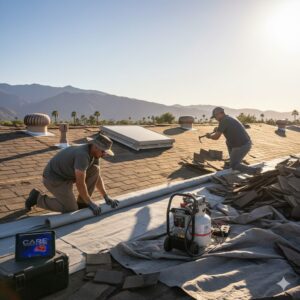
Professionals at firms like Care Roofing Inc. carry these tools onsite, enabling rapid response. For DIY enthusiasts, start small, but complex repairs demand certified expertise to avoid warranty voids or failures.
Common Challenges and How to Overcome Them
One challenge is distinguishing hail damage from natural aging. UV degradation mimics dents—brittle, chalky coating versus sharp impacts. Probe and compare: hail leaves clean fractures, aging shows even wear. Another is moisture intrusion; trapped water softens foam, requiring full removal.
Adhesion issues arise if prepping skips priming. Always test bond strength post-scarify. Extensive damage might reveal substrate problems, like rusted metal decks, needing separate fixes. Time delays exacerbate issues—UV-exposed foam degrades fast, demanding prompt action.
Solutions involve meticulous documentation, pre-repair testing, and layered quality checks. Partnering with experienced providers, such as those detailed on Professional Spray Foam Roof Repair Services, ensures overcoming these hurdles effectively.
Cost Considerations for Spray Foam Roof Hail Repairs
Repair costs vary by damage extent. Minor fixes run $2-5 per square foot, covering caulk and spot coats. Moderate repairs, with scarifying and re-foam, hit $8-15 per square foot. Severe or full recoats range $15-25 per square foot, including materials and labor.
Factors influencing price: roof access, size of affected area, material choices, and add-ons like warranties. Insurance often covers hail damage, offsetting expenses—document everything for claims. Long-term, repairs save over replacement, which can exceed $10-20 per square foot for new SPF installs.
Recoating every 10-15 years maintains value, with material warranties up to 10 years and no-dollar-limit systems longer. Investing upfront in quality repairs yields decades of protection.
Preventive Maintenance to Minimize Future Hail Damage
Proactive care extends SPF roof life post-repair. Annual inspections check for early dents, cracks, or ponding. Clean debris quarterly, pressure wash yearly to remove grit accelerating wear.
Recoat proactively every 7-10 years, matching original chemistry. Add granule-embedded coatings for hail resistance—ceramic granules absorb impacts better. Monitor weather forecasts; secure loose items pre-storm to cut wind debris risks.
Explore impact-resistant upgrades, like thicker foam or urethane coatings shown to resist hail better than acrylics. Regular maintenance contracts with specialists keep roofs optimal.
Benefits of Professional Repair Services
DIY suits minor spots, but pros bring expertise. They use advanced diagnostics, like drone surveys for hard-to-reach areas, ensuring no missed damage. Certified applicators guarantee compatibility, avoiding peel-offs or leaks.
Companies like Care Roofing Inc. offer warranties post-repair, providing peace of mind. Their experience with Comprehensive Commercial Roofing Expertise spans diverse projects, delivering reliable outcomes every time.
Case Studies: Real-World Hail Repair Successes
Consider a commercial flat roof hit by golf-ball-sized hail. Dents covered 30% of the surface, with foam cracks in high-impact zones. Technicians scarified affected areas, re-foamed 1.5 inches, and applied silicone coating with granules. Post-repair, the roof passed flood tests, earning a 10-year warranty.
Another case: widespread 1-inch dents from severe storm. Infrared revealed minor moisture; full prep included grinding, priming, and recoat. The result? Seamless restoration, no leaks after two years, outperforming adjacent shingle roofs needing full tear-offs.
These examples highlight SPF’s repair prowess, saving 60-70% over replacements while boosting energy efficiency via renewed insulation.
Long-Term Durability After Repairs
Properly repaired SPF roofs match new performance, lasting 20-50 years with maintenance. The seamless design resists leaks, while recoats restore reflectivity, cutting cooling costs 20-30%. Impact upgrades prepare for future storms, making SPF a smart, resilient choice.
Track performance via annual checks; recoat as needed to sustain benefits. Home and business owners enjoy lower lifecycle costs and superior protection.
Frequently Asked Questions
Can spray foam roofs be repaired after hail damage?
Absolutely, spray foam roofs excel at post-hail repairs due to their seamless, resilient nature. Hail typically causes surface dents, cracks, or coating breaches, but the underlying foam membrane—at least 1-inch thick—prevents widespread leaking. Repair methods scale with severity: caulk for minor pits under 1-inch, scarify and re-foam for moderate gouges up to 1.5 inches, and full rebuild for severe erosion. Professionals assess via grid counts (dents per 100 sq ft) and infrared scans for moisture. Post-repair, roofs regain full waterproofing and UV protection, often with renewed warranties. This targeted approach saves 50-70% versus full replacement, extending service life 20+ years. Always use compatible materials like silicone over silicone for adhesion. With expert execution, your SPF roof emerges stronger, ready for future weather events.
How do you assess hail damage on a spray foam roof?
Assessment begins with a visual grid survey: divide the roof into 10×10 ft sections, count dents/cracks per 100 sq ft. Minor: <10 hits, coating only; moderate: 10-20, foam penetration; severe: >20, erosion. Probe depths (1/8-3/4 inch common), check flashings, splits, and abrasion. Use infrared thermography to detect moisture in foam—wet areas show thermal differences. Inspect substrate for structural compromise. Document with photos for insurance. Distinguish hail (sharp edges) from aging (chalky wear). This systematic process, per industry standards, ensures accurate repair planning, preventing overlooked issues like hidden leaks. Professionals complete this in a day, providing detailed reports. Early detection minimizes costs and preserves roof integrity.
What materials are used to repair hail damage on SPF roofs?
Key materials include compatible caulks/sealants (silicone for silicone coatings), elastomeric roof coatings (acrylic, silicone, urethane), SPF foam kits, primers, and granules. For minor fixes, roofing-grade mastic fills holes after debris removal. Moderate/severe: scarify to sound foam, prime, spray 1-inch+ new SPF, then 20-30 mils coating in multiple passes. Granules broadcast into wet topcoat boost hail resistance and UV protection. Match original chemistry to avoid delamination—e.g., urethane coatings resist hail better. Quality products from reputable suppliers ensure durability. Pros also use vacuums for clean prep and testing agents for adhesion verification. These restore the monolithic barrier, matching new-roof performance. Stocked by specialists, they enable quick, effective restorations.
How long does it take to repair a spray foam roof after hail?
Timeline depends on damage scope: minor repairs (isolated dents) take 1-2 days, including prep, caulking, and curing. Moderate (scarify/re-foam areas) spans 3-5 days for 5,000 sq ft. Severe or full recoats require 1-2 weeks, factoring drying between coats. Weather impacts scheduling—dry conditions ideal. A team of 4-6 pros handles most jobs efficiently: Day 1 inspection/prep, Day 2-3 re-foam/coating, final testing. Larger roofs or access challenges extend time. Post-repair cures fully in 7-14 days before full exposure. Insurance approvals add days. Compared to tear-offs (weeks-months), SPF repairs minimize disruption, getting structures back online fast. Pros coordinate to accelerate, often completing commercial jobs weekend-to-weekend.
Is it cheaper to repair or replace a hail-damaged spray foam roof?
Repairing is far cheaper—$2-25/sq ft vs. $10-30/sq ft for full replacement. Minor: $2-5/sq ft; recoats: $15-25/sq ft, saving 50-80% over new installs. Insurance typically covers repairs fully for hail, as SPF’s leak resistance limits interior damage. Long-term, repairs preserve insulation R-value, cutting energy bills 20-30%. Replacement suits only substrate failure or 50%+ damage. Sustainable practices favor repair, reducing landfill waste. Factor warranties: repairs renew 5-10 years; new systems 20+. ROI favors fixing, especially on 20-year-old roofs recoatable multiple times. Get quotes showing total ownership costs—repairs win for resilience and economy. Experts optimize budgets, maximizing coverage.
Can I repair spray foam roof hail damage myself?
DIY works for tiny, isolated dents: clean, caulk with compatible sealant, spot-coat. Tools needed: grinder, vacuum, sealant gun. However, moderate+ damage demands pros—improper scarifying risks weak bonds, moisture traps leaks. Infrared needs expertise; mismatched materials cause peeling. Safety on roofs is hazardous without harnesses. Warranties void with amateur work. Success rate drops without training; failures lead to costlier fixes. For anything over 10 sq ft, hire certified applicators. They ensure code compliance, insurance eligibility. Self-assess minor spots, but scale up professionally for reliability. Resources guide basics, but experience trumps for complex jobs. Protect your investment right.
What if hail damage caused leaks in my spray foam roof?
Leaks signal foam penetration—urgent repair needed. First, contain interior water, then inspect: probe dents for depth, scan for wet zones. Remove damaged SPF fully, dry substrate, re-foam voids, seal, coat. Moisture-laden foam delaminates, so excise completely. Flashings often fail too—resecure. Post-fix, flood-test sections. SPF’s seamlessness limits spread, unlike shingles. Repairs restore watertightness fast. Delays worsen via UV/moisture degradation. Insurance covers if documented. Pros use non-invasive dries before rebuilds. Prevent via maintenance. Repaired roofs outperform pre-damage, with enhanced coatings. Act swiftly for minimal disruption.
How often should I recoat a spray foam roof after hail repair?
Recoat 7-10 years post-repair, or sooner if 20% wear shows. Inspect annually: chalking, granule loss signal time. Full recoats every 10-15 years extend life 20-50 years. Process: wash, fix mechanics, prime, coat 20-30 mils, granulate. Matches original chemistry for warranty renewal. Hail-repaired roofs benefit from impact-resistant urethanes/granules. Track via photos/logs. Neglect shortens life; diligence sustains performance. Budget $1-2/sq ft yearly reserve. Pros schedule efficiently, minimizing downtime. Proactive recoats prevent minor hail issues escalating. Your roof stays peak condition long-term.
Does hail repair affect my spray foam roof warranty?
No, professional repairs using OEM materials renew/extend warranties. Material warranties: 5-10 years; system no-dollar-limit: 20+. Pre-repair inspection required, often infrared. Document process for claims. DIY voids coverage. Compatible chemistry, proper thickness ensure validity. Post-repair certifications confirm compliance. Hail damage qualifies for insurance-backed extensions. Providers like Care Roofing Inc. issue guarantees. Verify terms: recoats often reset clock. Strong repairs enhance warrantied durability. Consult specialists for seamless warranty maintenance. Peace of mind included.
Are spray foam roofs more hail-resistant after repair?
Yes, upgrades during repair boost resistance. Add thicker foam, granule-embedded coatings, or urethanes outperforming acrylics. Granules absorb impacts; silicone flexes better. Post-repair systems handle 2-inch hail better than originals. Scarified areas gain strength from fresh bonds. Full recoats restore reflectivity, reducing thermal stress. Data shows repaired SPF survives storms neighboring roofs don’t. Maintenance sustains gains. Invest in premium layers for future-proofing. Resilience amplifies with expertise. Hail becomes less threatening.
Conclusion
Spray foam roofs stand out for hail repairability, offering cost-effective, durable solutions that outpace traditional replacements. From minor caulks to full recoats, targeted fixes restore peak performance. Partner with proven experts for optimal results, ensuring your roof weathers any storm.